
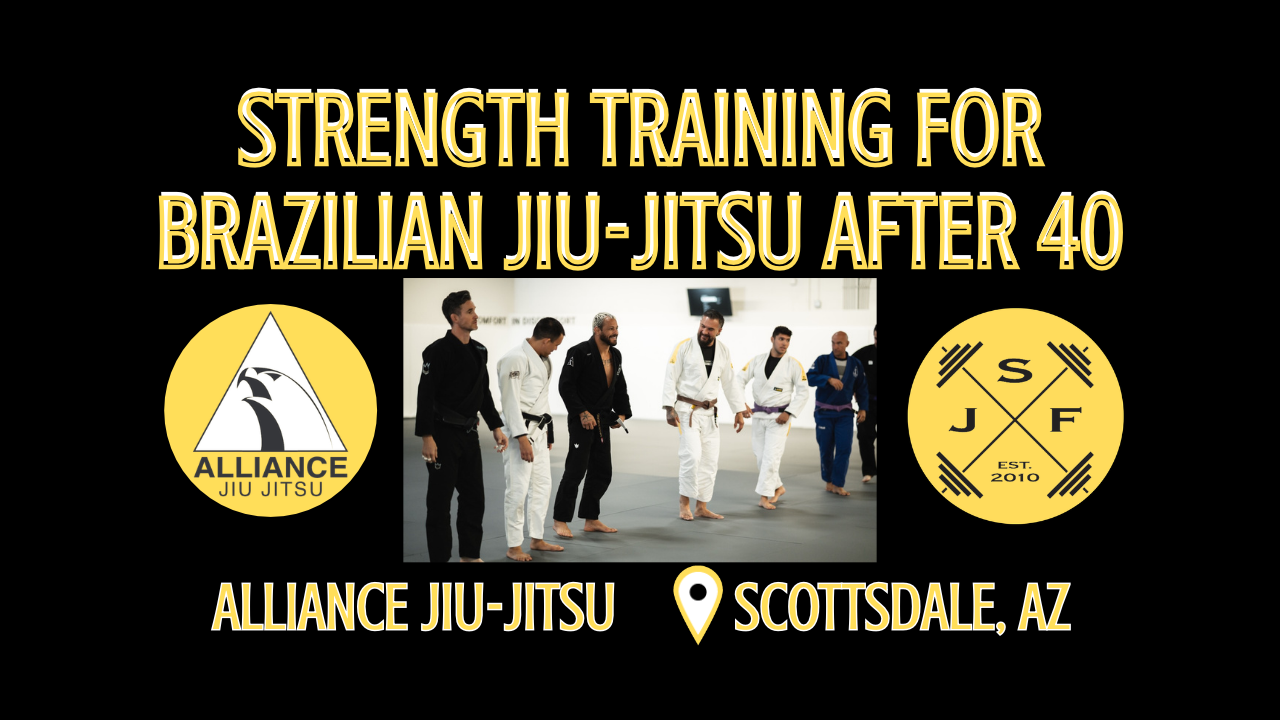
Strength Training for Brazilian Jiu-Jitsu After 40: Get Stronger Without Destroying Yourself
If you're training Brazilian Jiu-Jitsu in your 40s, there's something you figure out pretty quickly.
Your body has to be able to handle the work.
Not just the lifting.
Not just the conditioning.
The actual physical demands of grappling with another human being who is actively trying to control you.
It's a different animal.
I'm 43, I've spent years coaching strength and conditioning, and recently I've been learning Brazilian Jiu-Jitsu myself.
And one thing has become very clear.
Being strong helps, but knowing how to train intelligently matters even more.
Why BJJ Athletes Need Strength Training
Brazilian Jiu-Jitsu requires a combination of strength, endurance, coordination, mobility, and technical skill.
You're constantly pulling, pushing, gripping, rotating, bracing, and changing positions.
Sometimes you're working hard for several minutes.
Sometimes you're trying to stay controlled and conserve energy.
A good strength training program can help improve your physical capacity for these demands.
But it doesn't replace actual time on the mats.
Technique and skill development come from practicing Brazilian Jiu-Jitsu.
Strength training is there to support your training, not compete with it.
The Five Strength Training Priorities for BJJ
You don't need 27 different exercises to get stronger for grappling.
Start with the basics.
1. Lower-Body Strength
Your legs and hips play a major role in generating force, changing positions, and maintaining stability.
Exercises worth considering include:
Goblet squats
Split squats
Reverse lunges
Romanian deadlifts
Step-ups
Choose variations that work with your current mobility, injury history, and training experience.
2. Pulling Strength
Pulling is a major component of grappling.
Rows, pull-ups, and other pulling movements can help develop your upper back and arm strength.
Some of my favorites include:
Chest-supported rows
One-arm dumbbell rows
Assisted pull-ups
Cable rows
Farmer carries
Don't forget that your forearms and grip already get plenty of work during BJJ.
You don't necessarily need to hammer them every day.
3. Core Strength and Control
Your core does more than help you look good at the beach.
It helps transfer force, control your trunk, and maintain position during movement.
Useful exercises include:
Dead bugs
Side planks
Pallof presses
Loaded carries
Bird dogs
Focus on quality, control, and progressive difficulty.
4. Upper-Body Pushing Strength
Push-ups, dumbbell presses, and other pressing variations can help develop balanced upper-body strength.
But don't force exercises that aggravate your shoulders.
BJJ already places substantial demands on the shoulders, elbows, and wrists.
Your lifting program should account for that.
5. Mobility and Movement Control
You need enough usable movement to train comfortably and perform techniques.
That doesn't mean trying to become a gymnast overnight.
Work on areas relevant to your needs, including the hips, shoulders, and thoracic spine.
Strength training through comfortable ranges of motion can also contribute to improved movement capacity.
How Many Days Should You Lift if You Train BJJ?
For many recreational BJJ athletes over 40, two or three strength sessions per week can be a practical starting point.
The right number depends on how often you're on the mats, how hard you're training, your recovery, and your overall schedule.
If you're rolling hard several times a week, you probably don't need to crush yourself with maximum-effort lifting every day.
Think about your total training workload.
BJJ counts.
Walking counts.
Conditioning counts.
Strength training counts.
Your body doesn't magically separate all those activities into different recovery accounts.
A Simple 30-Minute Strength Workout for BJJ
Here's an example of a basic full-body session for someone with appropriate training experience.
Warm-up: 5 minutes
Easy bike or row, followed by controlled mobility work.
Strength block: 20 minutes
Perform two or three rounds with appropriate rest:
Goblet Squat: 8–10 reps
Dumbbell Romanian Deadlift: 8–10 reps
Chest-supported Row: 10–12 reps
Push-up or Dumbbell Floor Press: 8–12 reps
Farmer Carry: 30–40 seconds
Finish: 5 minutes
Easy aerobic work or gentle movement to cool down.
Use loads that allow good technique and leave some repetitions in reserve.
This is an example, not a universal prescription. Adjust exercises and volume to your ability and any medical or injury considerations.
What About Conditioning for Brazilian Jiu-Jitsu?
One of the best ways to improve your ability to perform BJJ is to practice BJJ.
But supplemental aerobic training can help build general endurance.
Walking, cycling, rowing, and other low-impact activities can be useful.
You can also include intervals when your recovery and training schedule allow.
The mistake is assuming every conditioning session needs to be an all-out death march.
If you're already doing demanding rounds on the mats, additional hard intervals may not be the smartest choice every week.
Build your aerobic base and use high-intensity work strategically.
Recovery Matters More Than Your Ego
This is especially important for busy adults.
If you're balancing work, family, strength training, and Brazilian Jiu-Jitsu, you need to manage your recovery.
Prioritize sleep.
Eat enough to support your activity.
Stay hydrated.
Adjust training when you're unusually fatigued.
And don't ignore persistent pain.
You don't get bonus points for making yourself so sore that you can't move properly for the next three days.
Consistency wins.
Why I Train at Alliance Jiu-Jitsu North Scottsdale
I've been learning Brazilian Jiu-Jitsu at Alliance Jiu-Jitsu North Scottsdale, and it's been a great reminder of what it feels like to be a beginner.
My coach, Gio, has been outstanding.
He's patient, incredibly knowledgeable, and great at breaking down technical details.
As a coach myself, I appreciate the way he teaches.
He understands that learning takes time and that students need clear instruction, repetition, and feedback.
Alliance offers adult Brazilian Jiu-Jitsu training in North Scottsdale for people looking to develop their grappling skills and become part of a martial arts community.
If you've been thinking about starting, check out Alliance Jiu-Jitsu Scottsdale.
Scottsdale Strength Training for BJJ and Busy Adults
At Jeremy Scott Fitness, our goal is to help adults build strength, improve conditioning, and stay physically capable.
That includes people who train martial arts, play recreational sports, hike, golf, or simply want to keep up with their kids.
Our coached group training sessions are approximately 30 minutes, making them practical for busy adults who don't have unlimited time.
We also offer personal training for people who want more individualized coaching.
The goal is simple.
Build a stronger body that supports the things you enjoy doing.
Ready to Get Stronger?
If you're looking for strength training or personal training in North Scottsdale, come check out Jeremy Scott Fitness.
Whether you're a recreational BJJ athlete or someone who just wants to get stronger and healthier, we'll help you build a realistic fitness routine.
Start Training at Jeremy Scott Fitness.
And if you're interested in learning Brazilian Jiu-Jitsu, visit Alliance Jiu-Jitsu North Scottsdale.
Train hard.
Train smart.
Keep showing up.
Make Success Mandatory.
Jeremy Scott
Jeremy Scott Fitness
Scottsdale, Arizona
